

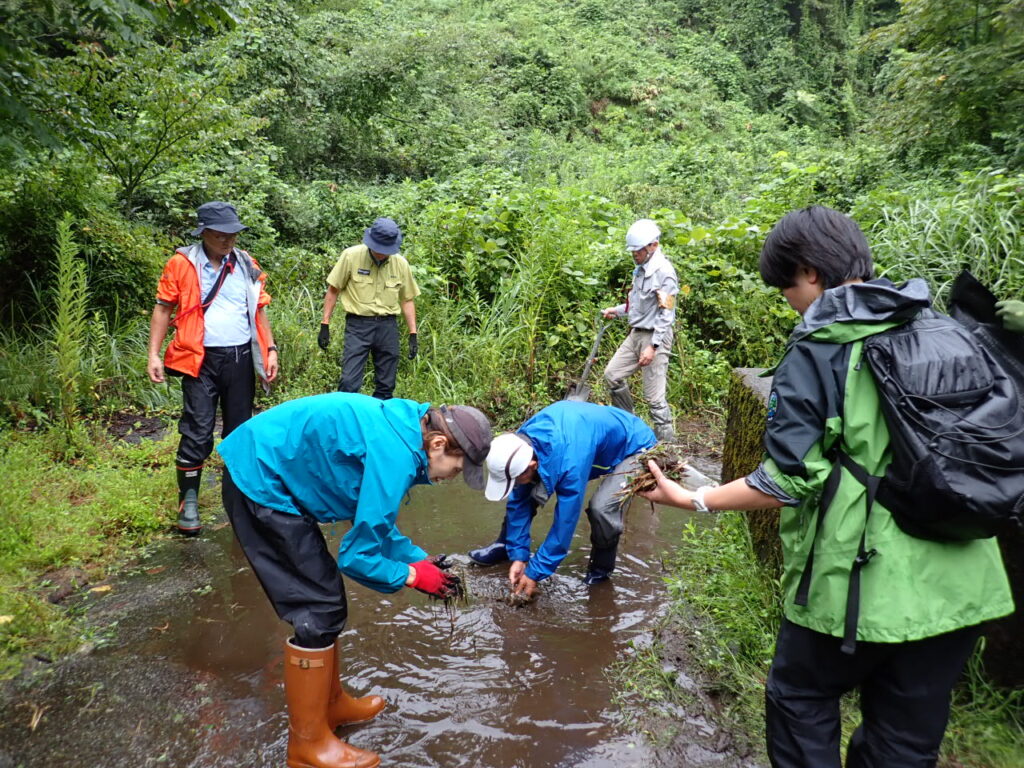
Image: The removal of Veronica anagallis-aquatica (water speedwell) in the Hoki Water Source Forest.
Credit: CCBJI
At the foot of Mount Daisen in Japan’s Tottori Prefecture, Coca-Cola Bottlers Japan’s (CCBJI) Daisen Plant produces mineral water for the ‘I LOHAS’ brand. In October 2026, the plant became the first site to achieve Platinum certification under the International Water Stewardship Standard (AWS Standard) Version 3.0 for the healthy freshwater ecosystems and their biodiversity outcome.
The Coca-Cola Company and its bottling partners have long been implementing water stewardship practices and certifying sites against the AWS Standard globally and in Japan. CCBJI’s Hakushu Plant and Coca-Cola (Japan) Company’s Moriyama Plant have already achieved AWS certification, making Daisen the third plant in Japan to receive certification under the AWS Standard.
The plant’s operations are closely connected to the surrounding water environment: all of the water used at the site comes from groundwater drawn from their own wells. This reliance on local groundwater makes understanding and protecting the health of the wider catchment, including its forests, freshwater ecosystems and biodiversity, an important part of how the site approaches water stewardship.
The site was already actively involved in conservation through a partnership with Tottori Prefecture and Hoki Town, and working with the Tottori Hino Forestry Association, supporting forest management and biodiversity activities in the Hoki Water Source Forest. The company has also organised indicator-species surveys and environmental learning activities involving employees, families and local communities.
From understanding the ecosystem to taking action
For Platinum level performance, the AWS Standard V3.0 requires sites to contribute to the restoration of degraded freshwater ecosystems and their biodiversity and to monitor and document progress. At Daisen, biodiversity monitoring provided an opportunity to put this into practice. A biological survey in the Hoki Water Source Forest had identified the spread of Veronica anagallis-aquatica, or water speedwell, an invasive alien plant growing alongside forest streams. Plans were already being developed to tackle the species, but at the time of the certification audit the restoration work had not yet taken place. The certification process helped turn that knowledge into action.
Working with biodiversity conservation specialists, invasive water speedwell was removed from an area of approximately 6.5 m², including affected soil where its roots and stems had spread. Rather than treating removal as the end point, the site developed an approach to monitor the recovery of native species and wider changes in biodiversity, while also watching for any re-establishment of the invasive plant. The site also developed a targeted monitoring plan during its flowering period to make it easier to identify regrowth and respond early where necessary. In this way, the biodiversity survey became the starting point for a cycle of evidence, action, monitoring and learning.
Building biodiversity into long-term water stewardship
The experience has also helped strengthen the way biodiversity issues can be managed in the future. The site developed a Biodiversity Issue Management Process covering how issues identified through surveys are assessed, how potential responses are considered, how action is planned and documented, and how its effectiveness is evaluated.
This took the action beyond the removal of one invasive plant and provided a repeatable approach for responding to future ecological challenges as new issues emerge. And importantly, this work extends beyond the factory boundary. The audit identified no freshwater ecosystems within the Daisen Plant itself, so achieving this outcome meant looking outwards to the wider catchment and the natural systems connected with the site’s water use. That is water stewardship in practice: recognising that managing water responsibly within a facility is only part of the picture.
A shared approach to water stewardship
The work in Hoki Water Source Forest is also rooted in collaboration. Coca-Cola Bottlers Japan’s conservation work brings together local government, forestry expertise, businesses and communities.
For its Platinum certification, the site demonstrated an approach to collective action that included shared objectives and responsibilities, joint decision-making and collaboration across sectors. This achievement is not about one company acting alone but about organisations working together to support the long-term stewardship of a shared landscape.
What certification adds
Perhaps the most interesting lesson from Daisen is that certification is not simply about recognising the environmental activities already underway. Independent assessment tests whether those activities meet the requirements of the AWS Standard and whether there is sufficient evidence behind them. During Daisen’s assessment, gaps were identified that the site needed to address before the Platinum requirements could be met. The resulting actions and evidence were reviewed, and the findings were closed before certification was awarded. That process helped move the site from conservation activity towards evidence-based restoration and ongoing ecological management.
The approach behind the intervention is significant: understand the ecosystem, identify an issue, act on the evidence, work with others, monitor what happens next and use that learning to guide future action. For organisations looking to strengthen their own approach to freshwater ecosystems and biodiversity, that may be one of the most useful lessons from the first Platinum certification under the AWS Standard V3.0.